
Contents
Network Overview
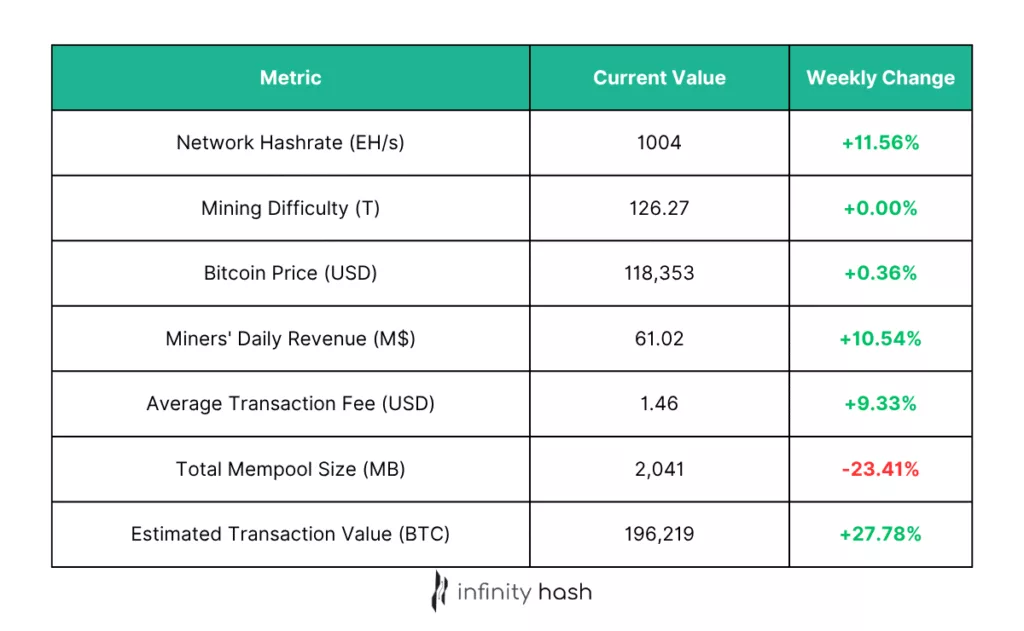
Bitcoin mining activity surged this week, with hashrate crossing the symbolic 1 ZH/s mark for the first time in history. Today difficulty also increased to record-high levels, which will be reflected on next week’s table. Nevertheless, the sustained high BTC price and an uptick in fees have contributed to recover some mining profitability. This hashrate spike suggests strong miner confidence and growing infrastructure investment. With transaction value and fees up, on-chain activity may be recovering after recent lulls.
Bitcoin Average Hashrate Breaks 1 Zettahash Milestone
Bitcoin just hit a historic mining milestone, as the average network hashrate surpassed 1 ZH/s (1,000 EH/s) for the first time ever. This unprecedented level of mining power comes alongside a new all-time high in network difficulty, now set at 127.62 T, and a record-low block time of just 8 minutes and 42 seconds. That is about 13% faster than the usual 10-minute average. The milestone shows that miners continue to invest in infrastructure despite tighter post-halving rewards.

In total over the past year, hashrate has increased by 70% and difficulty by nearly 30%, bringing additional resilience to Bitcoin’s security model. Although the latest difficulty adjustment was minor (+1.07%), it was enough to unlock these three records at once. With BTC hovering around $118,500, this momentum is evidence of miners’ long-term confidence in the network.
Source: u.today
Tether to Open-Source Bitcoin Mining OS by Year-End
Tether CEO Paolo Ardoino has confirmed that the company’s Bitcoin Mining OS (MOS) will go open-source by the end of 2025. Designed to scale from home setups to industrial farms, MOS offers miners full control over their infrastructure while reducing dependency on proprietary software. With support for diverse cooling and electrical systems, and integration with Tether’s decentralized AI platform QVAC, MOS aims to optimize mining performance and encourage wider participation, in an attempt to strengthen decentralization across the Bitcoin network.

The open-sourcing move comes amid Tether’s broader ambitions to become the world’s top Bitcoin miner by year-end. Alongside MOS, Tether is phasing out USDT support on five underused chains and focusing on high-activity networks like Ethereum and Tron. The firm has also expanded its mining footprint through a partnership with Ocean pool and a $600 million acquisition of a majority stake in Adecoagro. This aims to integrate USDT into commodities trade and tap into renewable energy for mining operations.
Source: coinedition.com
Illegal Mining Drives GPU Sales Surge in Russia
Video card sales in Russia have soared by over 200% in the first half of 2025, fueled by a surge in illegal cryptocurrency mining. With Bitcoin prices up and some regions offering cheap or stolen electricity, “black miners” are setting up secret GPU farms in basements, garages, and even near electrical substations. These operations are believed to have caused over 10 billion rubles ($125 million) in damages in 2024, a figure expected to be surpassed this year.
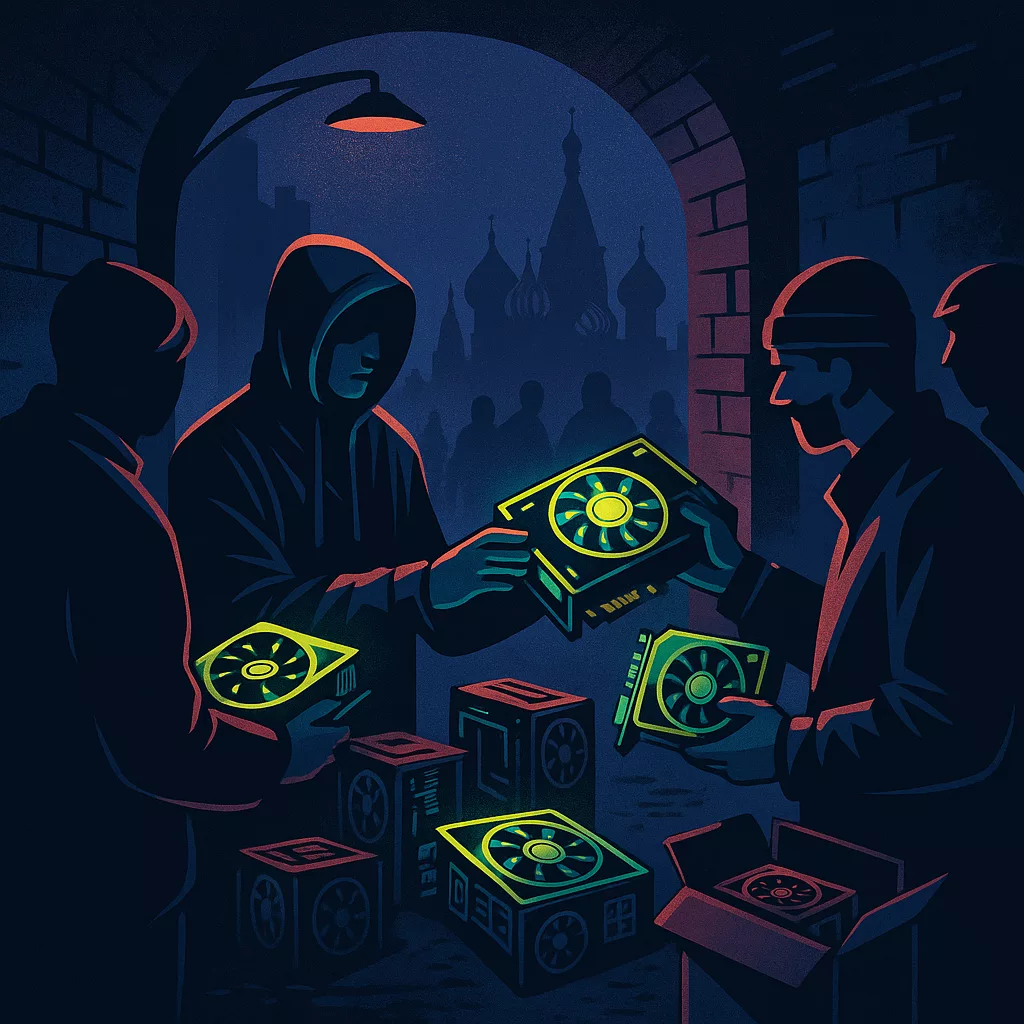
While some of the GPU demand is attributed to gaming and AI, experts see the spike as a strong indicator of growing illicit mining activity. The Russian government has banned mining in several regions and is considering stricter regulations, including cutting off power to legal farms during peak hours. Without firmer rules and enforcement, analysts warn Russia risks power outages and criminal exploitation on par with Iran and Kazakhstan.
Source: cryptopolitan.com
Bitmain Ships 187 Tons of Antminer Parts to U.S. to Bypass Tariffs
Bitmain has begun funneling massive shipments of electronic components totaling at least 187 metric tons to its U.S. affiliate in Delaware. This is a major logistics shift which came in response to looming U.S. tariffs on Chinese goods. By prioritizing the shipment of parts instead of fully assembled Antminers, the company aims to sidestep increased import duties and build machines domestically. This change comes as the Trump administration pushes for higher tariffs on Chinese electronics, putting pressure on global supply chains.

The move is part of a broader strategy to adapt to weaker post-halving demand and a more complex geopolitical landscape. It follows previous instances where Bitmain redirected unsold S19XP units to the U.S. for proprietary mining, many of which have since appeared on the books of Cango Inc., Bitmain’s newly public mining proxy. With competitors like MicroBT also importing components for local assembly, the changes are part of a wider trend among hardware makers to increase flexibility in response to the new tariff regime.
Source: bitcoin.com
Cango Completes Pivot From Car Financing to Global Bitcoin Mining Powerhouse
Cango Inc., a former Chinese automotive platform listed on the NYSE, has finalized its transformation into a global Bitcoin mining firm. After announcing its pivot in late 2024, the company now holds over 4,000 BTC and boasts a mining fleet with more than 50 exahashes per second of capacity. Its operations now span four continents, and the firm has explicitly stated its ambition to focus on green energy as part of its mining strategy.
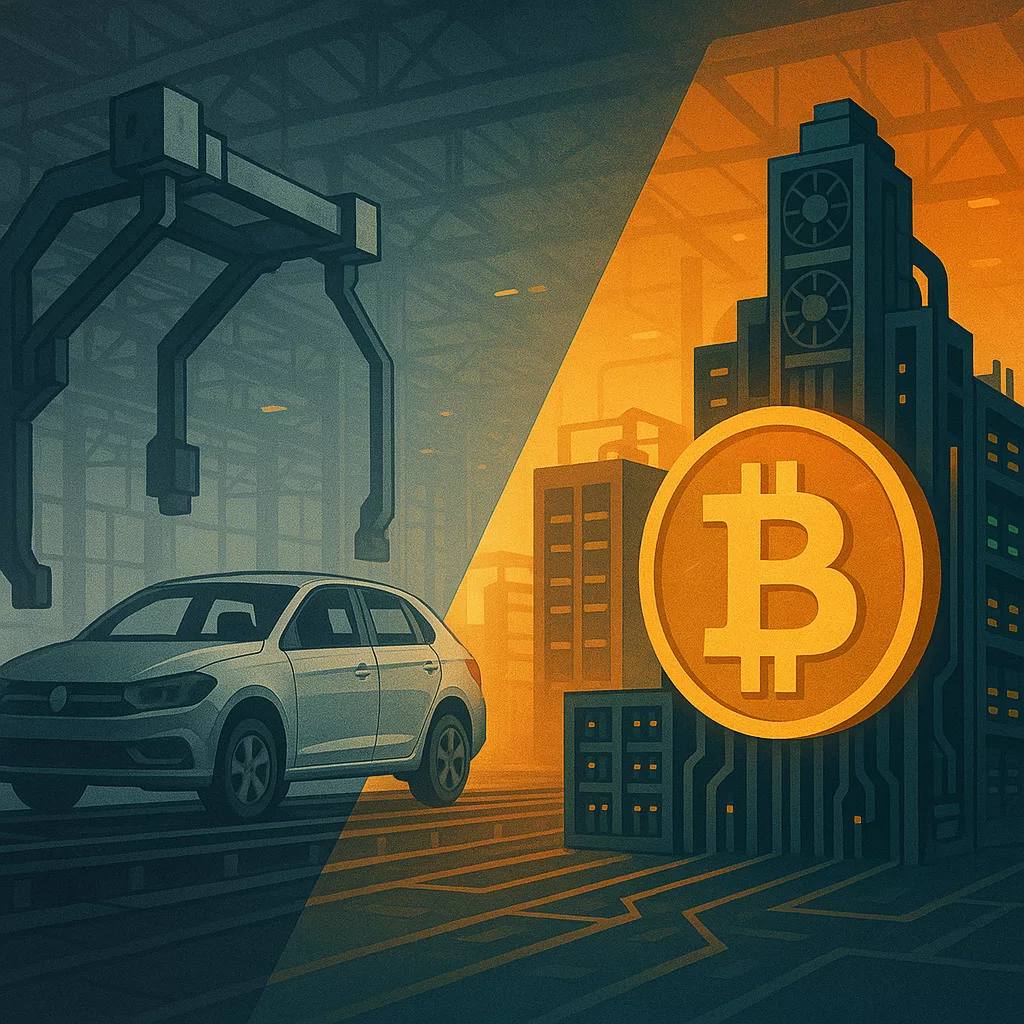
To support this major shift, Cango has also overhauled its leadership team. New CEO Peng Yu emphasized the company’s rapid progress, noting that it has already become one of the world’s largest Bitcoin miners. Cango mined 1,541 BTC in Q1 2025 and continues to expand aggressively. Having exited its original automotive business, the company is now directly competing with major mining players like Marathon, Riot, and CleanSpark.
Source: crypto.news
Jefferies Initiates Galaxy Digital With Buy Rating Amid Regulatory Tailwinds and AI Expansion
Jefferies has initiated coverage of Galaxy Digital with a buy rating and a $35 price target, seeking to benefit from favorable U.S. crypto regulation, particularly following the recent passage of the GENIUS Act. The investment bank sees Galaxy’s diversified model, spanning trading, asset management, and investment banking, as well-suited to capitalize on improving market structures. Jefferies also noted Galaxy’s growing involvement in AI infrastructure as a major catalyst for future growth.

A key factor behind the bullish outlook is Galaxy’s recent lease of a massive 393 MW data center site from CoreWeave in West Texas, which Jefferies called “a transformational deal.” The firm estimates that roughly two-thirds of Galaxy’s value now comes from its data center business, not its crypto operations. With the Bitcoin mining industry increasingly pivoting toward high-performance computing (HPC) and AI to diversify revenues, Galaxy’s foothold in both sectors may offer a compelling edge.
Source: coindesk.com
Bitfarms Shares Rise 8% After Announcing Share Buyback Program
Bitcoin miner Bitfarms announced a plan to repurchase up to 10% of its publicly traded shares, triggering an 8% rise in its stock price. The company aims to buy back nearly 50 million shares over the next year via the Nasdaq and Toronto Stock Exchange, with all repurchased shares set to be cancelled. This move reflects Bitfarms’ belief that its stock is significantly undervalued, especially in light of its expanding presence in high-performance computing (HPC) and AI infrastructure.

CEO Ben Gagnon emphasized that while the market currently undervalues their Bitcoin operations, it also overlooks the company’s long-term potential in AI and HPC. He highlighted Bitfarms’ energy portfolio in Pennsylvania as a key driver for future growth, suggesting that the firm can both return value to shareholders through the buyback and continue investing in scalable infrastructure. The announcement stood out in an otherwise weak market for miners, as Bitcoin briefly dipped below $118,000.
Source: coindesk.com
Bitcoin’s Minimum Fee Drops 90% Amid Low Network Activity
Bitcoin’s minimum transaction fee has dropped by 90%, now allowing users to send transactions for as little as 0.1 sat/vByte. This reduction is a consequence of the current slowdown in network activity, with fewer transactions and Ordinals inscriptions being broadcast. As demand for block space decreases, miners are more willing to accept lower-fee transactions in order to continue filling blocks and earning rewards, especially in an environment where fee-based revenue has dwindled.

The shift has reignited a debate about Bitcoin’s purpose: whether it should function as a payment network or remain a store of value. Figures like Jack Dorsey argue it needs to return to its payment roots to stay relevant, while others, including miners, suggest its use as a long-term asset is now its main role. Still, some users are celebrating the ultra-low fees, seeing them as an opportunity to transact cheaply on a normally expensive network.
Source: cryptopolitan.com